
Hari Iyer | SyncEzy
CEO 7 Min Read
 Jul 12, 2026
There’s a structural hole in the middle of the Australian HR software market, and almost nobody talks about it directly.
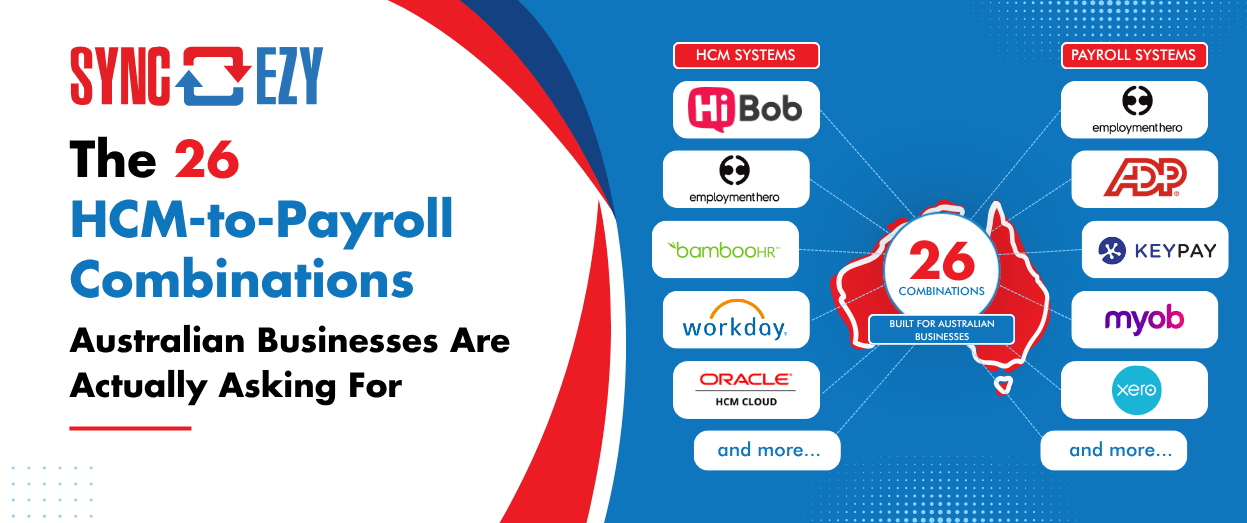
On one side: the global HCM platforms Australian companies increasingly run — HiBob, Workday, SAP SuccessFactors, Oracle HCM Cloud, BambooHR. World-class at people management, deliberately built without native Australian payroll, because modern awards, STP Phase 2, superannuation and EBA interpretation are a compliance domain unto themselves that global vendors sensibly leave to locals.
On the other side: the Australian payroll engines that actually do that work — Employment Hero Payroll (KeyPay), ADP Payforce, Dayforce (which absorbed Ascender), Frontier Software’s ichris, Aurion, Affinity Payroll, Definitiv, and at the smaller end Xero Payroll and MYOB.
Multiply one side by the other, and you get a grid of possible pairings — and in most cells of that grid, there is no deep, two-way, Australian-compliant connector. Just CSV exports, swivel-chair data entry, and payroll teams quietly absorbing the gap every cycle.
We build these connectors for a living. Over the past year we’ve mapped this landscape properly — which HCMs Australian businesses actually run, which payroll engines they pair with at each company size, and where a real integration is missing. That exercise produced 26 candidate combinations. This post is that map, published — along with an invitation: we’re deciding which of these to build next, and the fastest way to influence that decision is to tell us which one you need.
How a pairing makes the list
Not every theoretical combination is worth building, so we applied three filters.
First, both products need real Australian market presence in the same customer segment. Workday paired with a micro-business payroll product isn’t a real-world combination; Workday paired with the enterprise payroll engines that share its customer base is.
Second, there’s no deep native connector. “Deep” is doing real work in that sentence. Plenty of pairs technically have something — a marketplace listing, a one-way employee export, a partner-built sync that covers new hires and nothing else. Our bar is a two-way, field-complete integration that handles the full employee lifecycle (hire, change, leave, terminate), maps leave types to payroll leave categories properly, respects effective dates, and carries the STP Phase 2-relevant fields (employment basis, income type, cessation reasons) correctly. Very few pairs clear that bar. That’s the gap.
Third, the pairing reflects what businesses are actually asking about — search demand, inbound enquiries, and what we hear from the HR and payroll consultants who implement these platforms.
The map: 26 combinations
One of these we’ve already built — our HiBob ↔ Employment Hero Payroll connector is live and in production. The other 25 are in the field.
HiBob — the mid-market favourite, and the platform where we see the most Australian demand:
| # | Combination | Typical customer | Status | |
| 1 | HiBob ↔ Employment Hero Payroll (KeyPay) | 50–500 staff | Live — SyncEzy connector | Learn more |
| 2 | HiBob ↔ ADP Payforce | 200–1,000+ staff | Under consideration | Register interest |
| 3 | HiBob ↔ Dayforce payroll | Mid-market to enterprise | Under consideration | Register interest |
| 4 | HiBob ↔ Affinity Payroll | Mid-market, AU/NZ | Under consideration | Register interest |
| 5 | HiBob ↔ Frontier Software (ichris) | Mid to large | Under consideration | Register interest |
| 6 | HiBob ↔ Aurion | Mid to large, gov-adjacent | Under consideration | Register interest |
| 7 | HiBob ↔ Definitiv | Mid-market | Under consideration | Register interest |
| 8 | HiBob ↔ Xero Payroll | Under 200 staff | Under consideration | Register interest |
Workday — the enterprise standard, and the segment with the most painful manual workarounds because employee counts are large and change volume is high:
| # | Combination | Typical customer | Status | |
| 9 | Workday ↔ ADP Payforce | Enterprise | Under consideration | Register interest |
| 10 | Workday ↔ Employment Hero Payroll | Large mid-market | Under consideration | Learn more |
| 11 | Workday ↔ Frontier Software (ichris) | Enterprise | Under consideration | Register interest |
| 12 | Workday ↔ Aurion | Enterprise, public sector | Under consideration | Register interest |
| 13 | Workday ↔ Affinity Payroll | Enterprise, AU/NZ | Under consideration | Register interest |
| 14 | Workday ↔ Dayforce Payroll | Enterprise | Under consideration | Register interest |
SAP SuccessFactors — deeply embedded in Australian enterprise and government, with local payroll frequently run outside SAP:
| # | Combination | Typical customer | Status | |
| 15 | SuccessFactors ↔ ADP Payforce | Enterprise | Under consideration | Register interest |
| 16 | SuccessFactors ↔ Frontier Software (ichris) | Enterprise | Under consideration | Register interest |
| 17 | SuccessFactors ↔ Aurion | Enterprise, public sector | Under consideration | Register interest |
| 18 | SuccessFactors ↔ Affinity Payroll | Enterprise | Under consideration | Register interest |
| 19 | SuccessFactors ↔ Employment Hero Payroll | Subsidiaries of enterprise groups | Under consideration | Learn more |
Oracle HCM Cloud — similar profile to SAP: global core HR, local payroll engines underneath:
| # | Combination | Typical customer | Status | |
| 20 | Oracle HCM ↔ ADP Payforce | Enterprise | Under consideration | Register interest |
| 21 | Oracle HCM ↔ Frontier Software (ichris) | Enterprise | Under consideration | Register interest |
| 22 | Oracle HCM ↔ Aurion | Enterprise, public sector | Under consideration | Register interest |
| 23 | Oracle HCM ↔ Affinity Payroll | Enterprise | Under consideration | Register interest |
BambooHR — the SMB-to-mid-market entry point, where the payroll partners are different, but the gap is identical:
| # | Combination | Typical customer | Status | |
| 24 | BambooHR ↔ Employment Hero Payroll (KeyPay) | 20–200 staff | Under consideration | Register interest |
| 25 | BambooHR ↔ Xero Payroll | Under 100 staff | Under consideration | Register interest |
| 26 | BambooHR ↔ MYOB payroll | Under 100 staff | Under consideration | Register interest |
What the map tells you about the market
A few patterns worth calling out, because they explain why this hole persists.
The payroll side is consolidating; the HCM side is fragmenting. Ascender disappeared into Dayforce. KeyPay became Employment Hero Payroll. Meanwhile, the HCM side keeps adding entrants, and every merger or rebrand on the payroll side breaks whatever shallow point-to-point connections existed. A landscape this fluid punishes one-off, internally built integrations — the ground literally moves under them.
The enterprise pairs are the most underserved relative to their pain. A 2,000-person Workday shop paying through ichris or Aurion has enormous change volume — every hire, promotion, secondment, and termination crossing the gap — and yet these are exactly the combinations most likely to be bridged by a fragile in-house middleware script written years ago by someone who has since left. (We’ve written before about what that maintenance burden really costs — see our Build vs. Buy analysis.)
The compliance layer is the moat. The reason a global marketplace connector rarely fills these gaps properly is that the hard part isn’t moving JSON between two APIs. It’s knowing that employment basis has to survive the trip intact for STP Phase 2, that leave types need deliberate mapping to payroll leave categories, that a termination has to carry a valid cessation reason, and that superannuation fund details have their own rules. Australian payroll knowledge is the actual product; the API plumbing is just how it’s delivered.
Every pair on this list is the same integration wearing different logos. Employee master data, leave, terminations, effective-dated changes, compliance fields. Having built this deeply once — and lived with it in production through pay cycle after pay cycle — we know the shape of the problem, which is exactly why we’d rather let demand pick the next connector than guess.
How “under consideration” works — and why your vote genuinely matters
Here’s our honest process, because we think transparency beats mystery.
Each combination above gets a landing page on our site. When you register interest on one, that’s a demand signal that goes straight into our build prioritisation — we weigh the number of registrations, the size and urgency of the businesses behind them, and whether early registrants are willing to be design partners. Design partners get direct input into field mappings and workflow decisions (the details that determine whether an integration actually fits how you run payroll), early access, and founding-customer pricing.
This isn’t a marketing veneer over a predetermined roadmap. Our live HiBob ↔ Employment Hero Payroll connector exists because specific customers brought us specific pain. The next four or five connectors on this list will exist for the same reason — and the ordering is genuinely up for grabs.
If your combination isn’t on the list
The 26 above are where we see the clearest demand, but the map isn’t the territory. If you’re running an HCM-payroll pairing we haven’t listed — a different HCM, a New Zealand payroll engine, a rostering platform in the middle of the flow — tell us anyway. Several of our best product decisions started as an enquiry that didn’t fit any page on our website.
The gap between global HR platforms and Australian payroll isn’t going away; if anything, every new HCM entrant and every payroll consolidation widens it. Someone has to keep bridging it properly — deep, two-way, compliant, maintained. Tell us which bridge you need next.
Author
Hari Iyer | SyncEzy
CEO

Hari Iyer is the Founder and CEO of SyncEzy, a pioneering company at the forefront of data integration and automation solutions. With a deep understanding of the power of technology and a passion for solving complex business challenges, Hari has emerged as a visionary leader in the industry. His relentless pursuit of excellence and commitment to delivering tangible results have earned SyncEzy a loyal global clientele.
He is not only a successful entrepreneur but also an active contributor to the technology community, sharing his insights through thought leadership articles, speaking engagements, and mentorship programs. Hari’s ability to navigate the complexities of remote work serves as an inspiration for leaders, highlighting the importance of flexibility, work-life balance, and a results-oriented approach in today’s evolving work landscape.
Under his guidance, SyncEzy has gained widespread recognition for its deep integration solutions that seamlessly connect software applications, eliminate data silos, and enhance operational efficiency.
When not working, Hari is trying to be a better father, reading tech news, playing FPS games, and not exercising as he should.