
Hari Iyer | SyncEzy
CEO 12 Min Read
 Jul 08, 2026
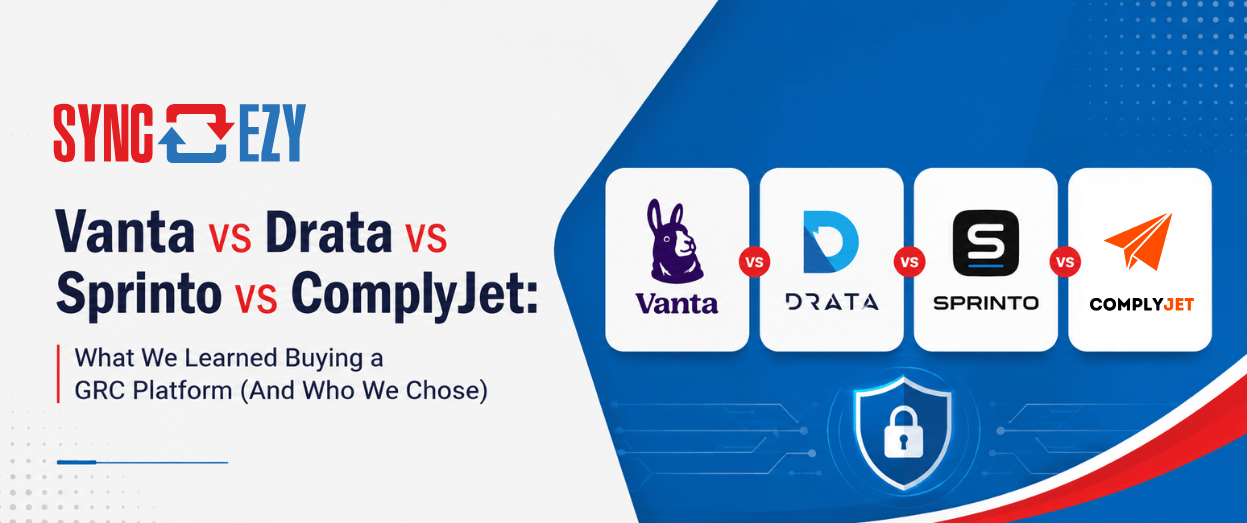
When we decided to rebuild our compliance program — moving off a GRC tool that had gone quiet after an acquisition, and expanding from SOC 2 alone to a combined SOC 2 Type 2 + ISO 27001 + Cyber Essentials Plus program — we did what we tell our own customers to do: a proper evaluation. Demos, trials, pricing negotiations, reference-checking, the lot.
We looked at four platforms: Vanta, Drata, Sprinto and ComplyJet. This post is our honest account of what each was like to evaluate and buy. A few disclaimers up front, because they matter: this reflects our experience during our evaluation window in 2026, for our specific needs, at our company size. Nobody paid us, nobody reviewed this before publishing, and your experience — especially on pricing, which every vendor negotiates — may differ. Treat this as one data point from a real buyer, not a verdict.
What we were actually buying
Context shapes everything in a comparison, so here’s ours. We’re an integration platform company of under thirty people across four countries, four years into SOC 2, with a Zoho-heavy stack alongside cloud infrastructure and Postgres. Our previous compliance life involved evidence being copy-pasted card by card into a Trello board for auditors, so our non-negotiables this time were blunt:
Continuous, API-driven evidence collection from our actual stack — not just the standard AWS/GitHub/Okta trio every platform demos with. This point deserves expansion, because it’s where most comparisons are useless: every GRC platform integrates with the first-tier tools. The evaluation is won and lost in the second and third tier — the tools unique to your workflow. For us that means the Zoho suite, which runs most of our business: Zoho CRM, our billing, our project management, and ManageEngine for endpoint management. Evidence about access reviews, device compliance, and change management lives in those systems for us — a GRC platform that can’t reach them isn’t automating our compliance, it’s automating a demo. Whatever your equivalent is — your niche ticketing tool, your regional HR system, your MDM — put it at the centre of every demo and watch what happens.
Beyond that: an auditor able to work natively inside the platform, so monitoring and audit are the same living system. One control set feeding SOC 2, ISO 27001 and Cyber Essentials Plus without triplicate work. Support for the parts of compliance that generate real workload for a vendor like us — above all, answering customer security questionnaires, of which we receive a constant stream. And pricing that a sub-thirty-person company can defend to itself annually.
Delve: The shadow over the whole category
One more thing shaped this evaluation, and it’s worth naming because it shaped our questions. In early 2026, the compliance automation space had its scandal: Delve, a Y Combinator-backed platform that raised $32 million at a $300 million valuation promising AI-driven compliance in days, was accused by a whistleblower of generating fake evidence, pre-populating auditor conclusions, and routing clients through audit firms alleged to be rubber-stamping templated reports — analysis of leaked draft reports found nearly all used identical boilerplate. Delve denies the allegations and attributes the leak to a malicious actor, but Y Combinator removed the company from its directory and parted ways with the founders.
Whatever the courts eventually conclude, the episode crystallised the failure mode of this entire category: compliance theatre at machine speed. A platform optimised purely for “certified fast and cheap” is optimised for exactly the wrong thing. So we walked into every demo with Delve-shaped questions: Who actually issues the audit opinion, and are they genuinely independent of the platform? Where does each piece of evidence come from — a live API connection to a source system, or something generated? Can we trace any control’s evidence back to the system it came from? All four platforms we shortlisted cleared that bar — we wouldn’t have shortlisted them otherwise — but if you’re running this evaluation yourself, ask those questions before you ask about features. The cheapest, fastest certificate in the market just cost several hundred companies their credibility.
With that lens, here’s how the four stacked up.
Vanta: the market leader, priced and behaving like one
Vanta is the category leader, and it shows — in good ways and less good ones. The integration library was the most mature of the four we assessed; the platform has clearly absorbed years of edge cases, and if your stack is mainstream, coverage is excellent. The product is polished, and the brand does carry weight with some security reviewers.
Where it fell down for us was value. The pricing we were quoted sat firmly at the top of the group, and when we mapped price against what we’d actually use, the equation didn’t close — we’d have been paying a meaningful premium for brand and breadth we didn’t need. The sales experience compounded it: there was a discernible air of “you need us more than we need you” through the process — the confidence of a market leader capitalising on its position. That’s a rational commercial strategy, and plenty of buyers will happily pay the leader premium for the safest logo. We’re just not the buyer that strategy works on. When you’re the company that answers other people’s hard questionnaires all day, being sold to from a pedestal lands badly.
A small thing that stuck with us, for what it says about where the premium goes: during our evaluation, Vanta was running LinkedIn ads offering a pair of AirPods — around $250 worth — for sitting through a demo. We get it; they’re a well-funded company and paid-demo incentives are a known growth tactic. But it sat oddly with us. We’re a bootstrapped-minded business that watches every dollar, and when a vendor is handing out $250 headphones per meeting, you know exactly whose subscription fees are buying them. Culture fit runs both ways in a vendor relationship, and that ad told us something about the fit.
Verdict for us: strongest integrations, weakest value, and a sales posture that assumed the sale.
Drata: we honestly can’t tell you
Here’s the shortest vendor review we’ll ever write: we reached out to Drata multiple times during this evaluation and never heard back. Not a slow response — no response. And this wasn’t a first-contact fluke; we’d approached them in the past as well, so this round of silence made the decision for us.
We won’t speculate on why — territory models, lead scoring, our company size falling below some threshold, simple CRM misfires. The product may be excellent; by reputation it’s a genuine top-two player. But we were a warm, funded, ready-to-buy prospect with a defined project, and we could not get a conversation. There’s a lesson in that for every SaaS company, ourselves included: your funnel leaks are invisible to you and unforgettable to the buyer.
Verdict for us: disqualified by silence.
Sprinto: the one that almost won
We went deepest with Sprinto — a full trial, multiple sessions, real work done in the platform. And there’s a lot to like. The AI-driven onboarding engine genuinely impressed us: it did a large share of the initial mapping and setup work that traditionally makes GRC implementations painful. The platform is very polished — arguably the slickest UX of the four, beautifully planned in a way that tells you it’s been shaped by years in the market. The people were genuinely lovely to deal with throughout, and for a company our size the headline pricing initially looked right too. We weren’t just leaning toward Sprinto — we were about to go ahead with them. This was the winner, pen hovering over paper.
Then, at the last minute, it came unstuck in the pricing conversation — and it’s the strangest structure we’ve encountered in years of buying SaaS: a three-year contract with the price increasing in years two and three. Locked-in, pre-agreed escalation — not CPI adjustment, not usage growth, just a ramp.
We sell multi-year deals ourselves, so we understand the logic of locking in customers. But when we price multi-year, the customer’s reward for committing is that the price doesn’t move. A discounted year one that ramps upward once you’re embedded is the opposite trade: it prices in your switching costs. It reminded us of the HubSpot playbook — attractive on entry, expensive once your data and workflows are inside and leaving is painful. Once we saw the structure, we couldn’t unsee it: if the year-three price is the real price, quote us the real price.
Verdict for us: best onboarding automation and the most polished product — undone by a pricing structure that treats commitment as leverage rather than loyalty.
ComplyJet: rough edges, right answers
ComplyJet is the newest entrant of the four, and it shows in both directions. Let’s do the honest negatives first: the product is rougher around the edges than Sprinto or Vanta. The trust centre is less polished and was missing features the incumbents have. If you scored these four platforms on UI maturity alone, ComplyJet finishes last, and we won’t pretend otherwise.
Here’s why we chose them anyway.
The team. Responsiveness through the evaluation was A+ — questions answered same-day, objections engaged rather than deflected, follow-ups that arrived before we chased them. Any tool is only as good as the people behind it, and a GRC platform is a multi-year relationship with the people even more than the software. We were effectively choosing a partner for our audit cycles; we chose the partner who behaved like one before we’d paid a dollar.
The hunger. For every objection we raised — a missing integration, a gap in the trust centre, a workflow that didn’t fit — the answer was some version of “yes, and here’s the date.” Remember the second-tier integration test from earlier? The connections we need into our Zoho-centric stack — CRM, billing, project management — and ManageEngine for endpoint compliance don’t all exist yet. But rather than a vague roadmap form, ComplyJet committed to building them as part of our signing, with dates attached. To be completely transparent: as of writing, those builds are commitments, not shipped features — our decision was made on price, the demos, and a hands-on test of the platform as it stands today. We’ll report back shortly on whether the commitments landed on schedule, and that follow-up will be the real test of this choice. But there’s a signal even in the willingness: a vendor who puts delivery dates against a sub-thirty-person customer’s integration requests is making a different kind of promise than one whose roadmap you’re not big enough to influence.
They took the trust centre seriously — as a sales tool. Here’s how we think about a trust centre: it’s not just a compliance checkbox; it’s the page your prospect’s security reviewer visits before deciding how hard to make your life. For a small vendor selling to enterprises, the specific features matter enormously. The ability to feature customer logos — social proof is half the battle when a reviewer is deciding whether a sub-thirty-person company is credible. A proper FAQ covering the questions every questionnaire asks anyway, so half the questionnaire answers itself. A published, always-current subprocessor list — the single most repeatedly requested artefact in every security review we face. And the ability for customers to subscribe to subprocessor updates, so change notifications happen automatically instead of via apologetic email blasts. ComplyJet’s trust centre is missing some of this today — but every item we raised went onto their commitment list with a delivery date as part of our deal, rather than into a suggestion box. Those features are promised, not shipped; we’ll be scoring them against their own dates in the follow-up post.
No plan-gating. This one matters more than it sounds. Several platforms in this space gate core functionality by tier — including limits on things like the number of security questionnaires you can process. For an integration vendor, answering customer questionnaires isn’t an occasional event, it’s a weekly workload; a per-questionnaire cap is a tax on our busiest compliance activity. ComplyJet doesn’t gate features by plan. What you buy is the platform, not a ration book.
Verdict for us: the least polished product, the best partnership — and the pricing and packaging honesty the others lacked.
The scorecard
| Vanta | Drata | Sprinto | ComplyJet | |
| Integration maturity | Best in group | Untested (no contact) | Strong | Gaps; ours committed with dates |
| Product polish | High | — | Highest | Roughest |
| Onboarding automation | Good | — | Best (AI engine) | Good |
| Sales experience | Aloof | Non-existent | Excellent | Excellent |
| Pricing/value | Premium, didn’t stack up | — | Escalating multi-year ramp | Fair, no plan-gating |
| Responsiveness to requests | Roadmap-driven | — | Good | Exceptional |
| Our outcome | Declined | Disqualified | Runner-up | Chosen |
What we’d tell another SaaS company running this evaluation
Four things travelled with us out of this process. First, demo with your real stack, not theirs — every platform looks complete against AWS and GitHub; the truth lives in your fourth and fifth integrations. Second, get the full multi-year pricing in writing before you fall in love — year one tells you nothing; the structure tells you everything about how the vendor thinks about you once you’re locked in. Third, test responsiveness during the sale, because it only degrades after it: the vendor’s behaviour as a suitor is the ceiling, not the floor. And fourth, weigh the people as heavily as the platform — you’re not buying software, you’re hiring a co-pilot for every audit you’ll run for years.
We’ll report back once we’re through our first combined SOC 2 + ISO 27001 cycle on ComplyJet — including whether the committed integrations and trust-centre features shipped on their promised dates, whether the rough edges smoothed out, and whether the responsiveness survived the signature. Our decision was made on price, demos, and a hands-on test; the follow-up post is where the commitments get marked against reality. If they deliver, this post gets a happy sequel. If they don’t, we’ll write that too.
Author
Hari Iyer | SyncEzy
CEO

Hari Iyer is the Founder and CEO of SyncEzy, a pioneering company at the forefront of data integration and automation solutions. With a deep understanding of the power of technology and a passion for solving complex business challenges, Hari has emerged as a visionary leader in the industry. His relentless pursuit of excellence and commitment to delivering tangible results have earned SyncEzy a loyal global clientele.
He is not only a successful entrepreneur but also an active contributor to the technology community, sharing his insights through thought leadership articles, speaking engagements, and mentorship programs. Hari’s ability to navigate the complexities of remote work serves as an inspiration for leaders, highlighting the importance of flexibility, work-life balance, and a results-oriented approach in today’s evolving work landscape.
Under his guidance, SyncEzy has gained widespread recognition for its deep integration solutions that seamlessly connect software applications, eliminate data silos, and enhance operational efficiency.
When not working, Hari is trying to be a better father, reading tech news, playing FPS games, and not exercising as he should.

Related Posts
Categories
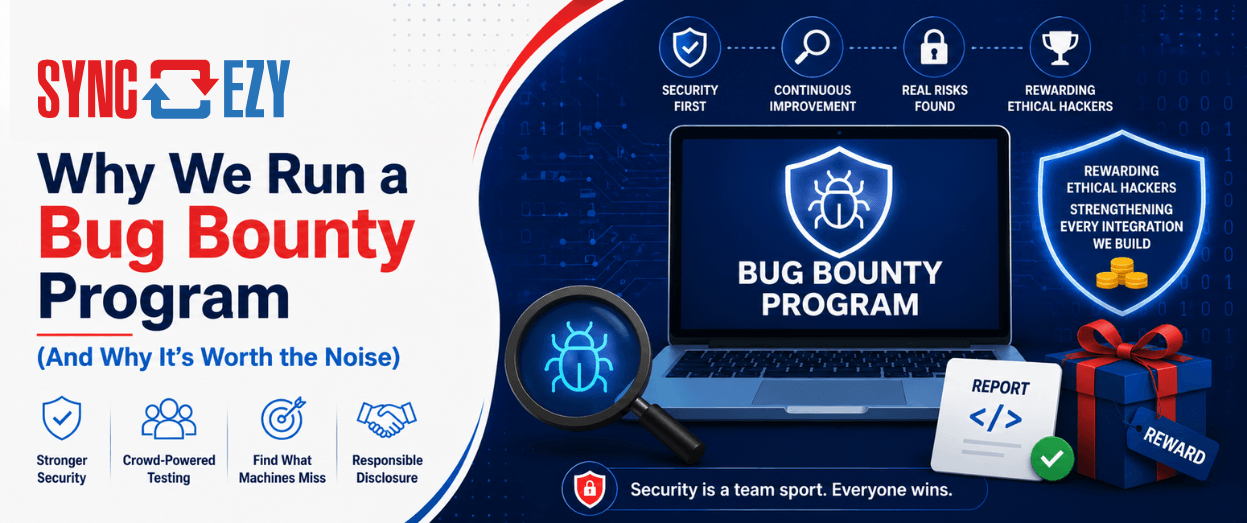
Why We Run a Bug Bounty Program (And Why It’s Worth the Noise)
We hold a SOC 2 Type 2 attestation and have done so for four years. We’re working through ISO 27001 and Cyber Essentials Plus right now. We do a full penetration test every year with an independent firm. And on top of all of that, we run a bug bounty program. If you’re a customer,… Continue reading Why We Run a Bug Bounty Program (And Why It’s Worth the Noise)
Hari Iyer | SyncEzy
CEO
Enhancing Data Security in a Post-Zero-Day World: The SyncEzy Commitment
Late Friday evening on 23rd June, as I was shutting down for the day, at 6.15 pm I received a concerned email from a customer in Singapore, Is SyncEzy protected against this Zero Day Exploit? This by the way is a perfect subject to get any TECH CEO to open the email immediately. As I opened… Continue reading Enhancing Data Security in a Post-Zero-Day World: The SyncEzy Commitment
Hari Iyer | SyncEzy
CEO
SyncEzy is SOC 2 Type 2 Certified Now
What is SOC 2 Type 2 Certification? SOC 2 Type 2 Certification is a Type of Certification that verifies that a service organization has established and implemented controls and procedures to safeguard the privacy, security, and confidentiality of customer data. SOC 2 (System and Organization Controls 2) is a set of auditing standards developed by… Continue reading SyncEzy is SOC 2 Type 2 Certified Now
Hari Iyer | SyncEzy
CEO
Information Security & Portal Access Using 2FA at SyncEzy
In a world where our computers are constantly generating huge amounts of new information, the issue of data security is becoming a very important one. Businesses today are asking themselves whether they can trust the safety of their sensitive information as it travels between so many interconnected devices. As a result of this, data security… Continue reading Information Security & Portal Access Using 2FA at SyncEzy
Hari Iyer | SyncEzy
CEO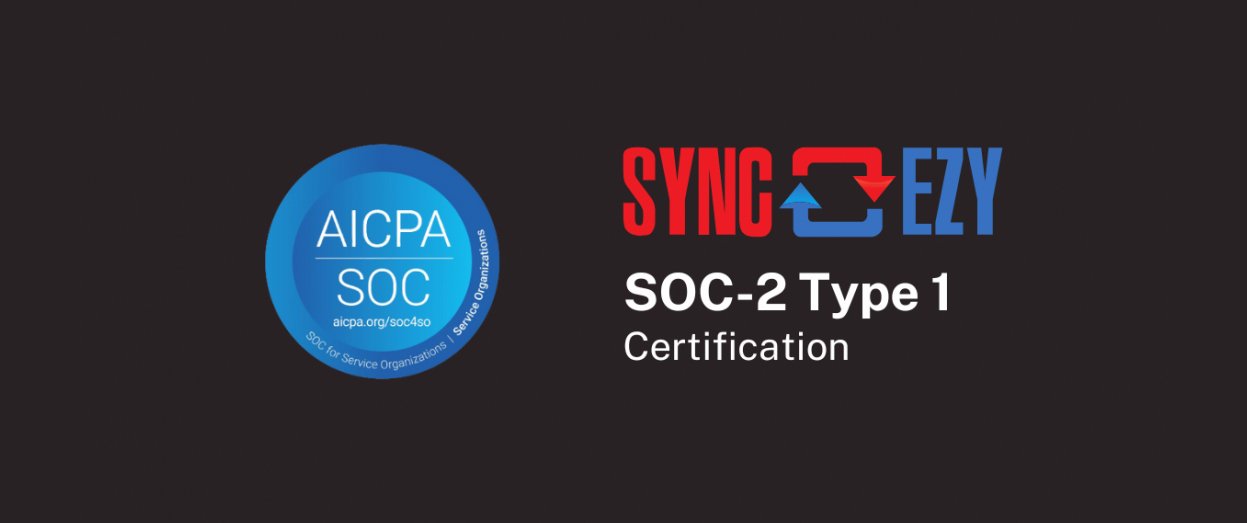
SyncEzy Security, SOC-2 and GDPR Information
SOC 2 Certification SyncEzy is certified for SOC 2. General Data Protection Regulation (GDPR) What is the GDPR? The GDPR is a comprehensive data protection law that came into effect on May 25, 2018. It replaced existing EU law to strengthen the protection of “personal data” and the rights of the individual. It’s a single… Continue reading SyncEzy Security, SOC-2 and GDPR Information
Hari Iyer | SyncEzy
CEO
SyncEzy offers 24 x 5 Support
As a company we have always put Support before Sales, This has been our philosophy from day one that if you take care of existing customers the business will take care of itself. Based on this philosophy, we always invested more in our support organization, in the ratio between our sales and support staff. The last thing we… Continue reading SyncEzy offers 24 x 5 Support
Hari Iyer | SyncEzy
CEO

