

Hari Iyer | SyncEzy
CEO 10 Min Read
 Aug 07, 2026
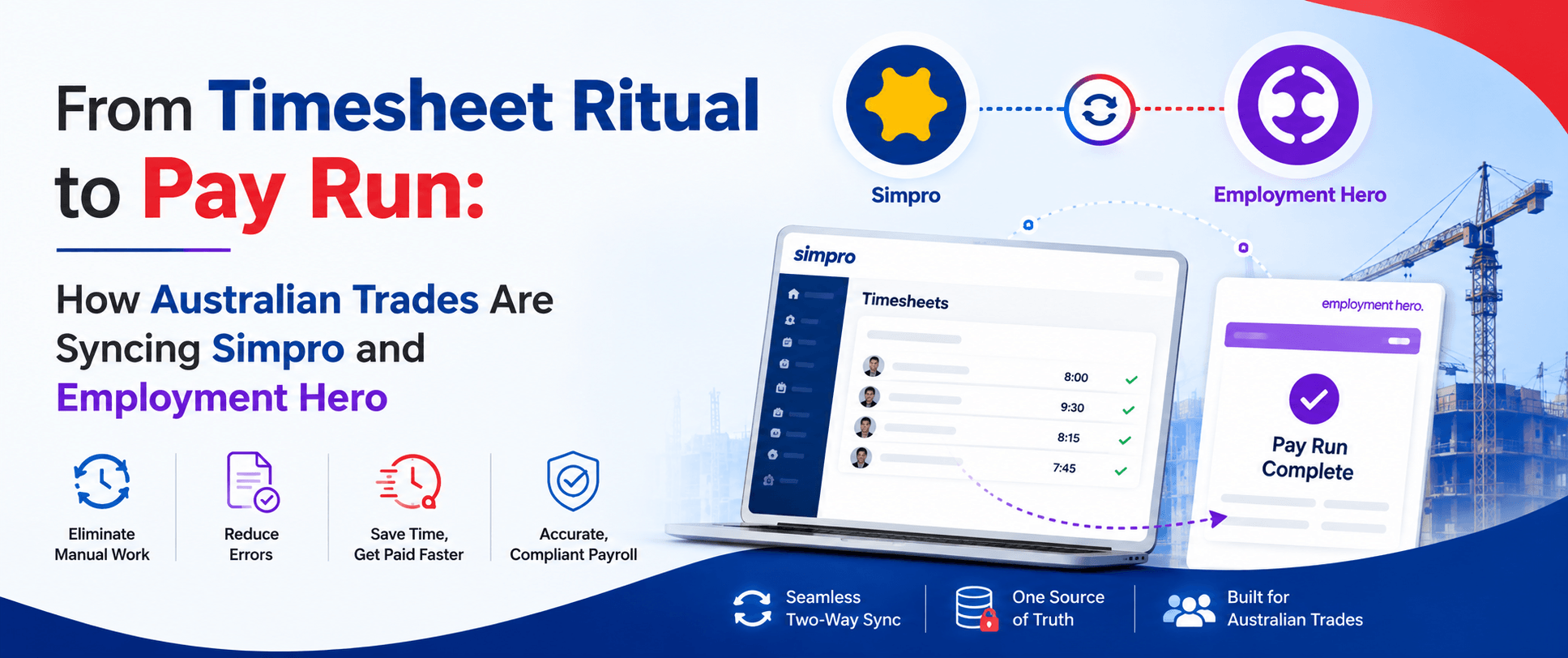
Ask an Australian trade business owner about Simpro and they’ll tell you it runs their operation. Jobs, scheduling, technicians in the field, hours logged against cost centres. It does that well.
Ask them about Monday morning, when those field hours have to become an actual pay run, and the tone changes.
That’s where the stress lives. Not in Simpro, and not in Employment Hero either. In the gap between them, where someone downloads a CSV export, fixes the formatting, re-keys the numbers, and hopes nothing got lost on the way through. We polled attendees at our recent webinar on how long a pay run takes them. The answers split fairly evenly between one to two hours and a full day.
This is the written version of that session, run with Chris from Employment Hero’s strategic partnerships team. Useful if you’d rather read than watch, or if you want something to hand to whoever actually processes your payroll.
▶ Watch the full webinar on demand (includes a live demo of the portal and pairing screens)
The problems we hear most
- Your team spends too much time manually entering hours into the payroll system. The hours already exist, accurately, in Simpro. Someone re-types them anyway.
- Making sure the right rates and allowances get paid is confusing, particularly with the range of awards in play. Unless the rules are properly built and the arriving data is properly categorised, every pay run involves judgement calls that shouldn’t be judgement calls.
- Incorrect information entered manually leads to rework and unhappiness among staff. As Garth from our team put it during the session: you don’t want to find out there’s a problem with people’s real money, because they take it very personally.
What actually flows between the two systems
The core of it is timesheets moving from Simpro into Employment Hero. But timesheets carry more than raw hours, and that detail is what makes the integration useful rather than merely convenient.
What comes across:
- Hours worked, against the jobs they were worked on.
- Activities, which cover leave, work types and allowances.
- Jobs and their schedule rates, so the work type attached to a job can drive the right pay treatment at the other end.
Take a realistic week. Your tech works two cost centres on one job, moves to a second job for a couple of days, puts in a long day on the Thursday, claims a meal allowance for the late finish and a tool allowance, picks up on-call for the weekend, then takes sick leave on the Friday. All of that arrives in Employment Hero intact and correctly categorised, ready for your pay rules to act on.
There are also two newer flows running the other way, from Employment Hero back into Simpro:
- New employees. When someone is created in Employment Hero, we can create them in Simpro too. Employment Hero is the point of truth for people, because onboarding happens in the HR system first.
- Approved leave. When leave is approved in Employment Hero, it lands on the Simpro schedule, so whoever is scheduling work can see availability.
How the pairing works
Setup is mostly a pairing exercise, and it runs in two directions depending on what’s being paired.
Employees pair with Employment Hero as the point of truth. We pull your Employment Hero employee list and match each person to their Simpro record. This direction matters because Simpro often contains contractors paid through invoicing rather than payroll, and those shouldn’t land in a pay run.
Activities pair with Simpro as the point of truth. Your Simpro activities are what your team actually logs: toolbox meetings, warehouse time, travel time, sick leave, public holidays, tool allowances. Each pairs to its counterpart in Employment Hero, which will be a leave type, a work type, or an allowance.
Work types are the interesting one. Tagging hours with a work type gives Employment Hero’s rules something to act on. If a job is tagged as on-call work, your rules can apply a different rate to those hours than to standard job time.
Schedule rates can also carry across. If you use schedule rates in Simpro, they can be tagged with a work type in Employment Hero, which then feeds the rules determining what gets paid.
Pushing a pay cycle through
Worth being straightforward: the push is currently a manual step, and we’re building the automation.
Here’s the cycle as it works today. Your team logs hours in Simpro as normal. Those hours get approved in Simpro, which is where we recommend you do your checking. Then on payroll day you come into the SyncEzy portal, fetch the timesheets for your date range, tick the ones you want, and send them to Employment Hero.
We’re currently developing scheduled fetching, so that on a set day each week or fortnight the timesheets pull through automatically and are already sitting in Employment Hero when you start. Until that ships, budget a couple of minutes per pay run.
Once the hours land in Employment Hero, you’ll find them in the timesheets section, grouped by date. You can regroup by employee to review each person’s week in one view. Allowances appear as line items with unit counts against the relevant job.
One thing that catches people out the first time: sick leave won’t appear in the timesheets view. It bypasses timesheets entirely and goes straight to the leave section as an approved request, then comes back into the calculation during the pay run. So if someone’s hours total looks light, check their leave before assuming data went missing.
What Employment Hero handles once the data lands
This is the half of the story that isn’t ours, and Chris covered it on the day.
His framing was direct: the primary reason trade businesses choose Employment Hero is that you don’t have to build the compliance rules yourself. It’s built from the ground up for Australian payroll compliance.
What that means practically:
- Modern award interpretation applies automatically to every pay run.
- Superannuation guarantee contributions are calculated and processed correctly, adapting to statutory rate changes as they happen.
- Single Touch Payroll submits directly to the ATO, without extra software or manual file workarounds.
- Penalties, overtime thresholds and public holiday rules are built in rather than maintained by you.
The trade-specific angle matters here. Trade payroll isn’t a standard nine-to-five desk setup. You’re dealing with complex allowances, travel time, height money, call-out rates and strict award structures. Employment Hero ships pre-built award and payroll setup templates tailored to common Australian trades, so you’re not coding payroll rules from scratch. You configure overtime triggers, penalty multipliers and trade allowances once during setup, and from that point they apply to every cycle.
Beyond the pay run, there’s a self-service mobile app for your technicians: real-time leave balances, leave requests, pay slips, bank detail updates. Approvals flow through automatically. On the HR side there’s paperless onboarding, digital employment contracts, and secure storage for licences and safety compliance documents.
And because Australian workplace legislation and Fair Work rates change constantly, Employment Hero updates in the background as those rules evolve.
Going live: ghost run, then shadow run
Nobody should discover a payroll problem on payday. The go-live process has two safety nets.
The ghost pay run comes first. We pull a previous week’s hours from Simpro, bring them through into Employment Hero, and run a pay run against them. This shows you exactly how your rules treat real hours for real staff. If something lands wrong, you find out on data that doesn’t matter. Then we delete it out.
The shadow pay run is your first genuine run. We make ourselves available and sit alongside you, so if anything behaves unexpectedly, we adjust on the fly.
Garth summed up the philosophy during the session: measure twice, cut once.
What setup actually takes
Shorter than most people expect, assuming you’re already running both systems.
The connection takes about 10 to 15 minutes. Employee pairing depends on headcount but moves quickly. The part requiring real thought is the activity pairing conversation, working through which Simpro activities map to which Employment Hero leave types, work types and allowances.
All up, a single one-hour meeting is normally enough to get connected and paired.
If you’re not yet on Employment Hero, that setup happens first and separately, then we come in and do our hour.
Multiple Simpro companies
Supported. If you run several Simpro businesses, we create a separate app per company, each connecting independently into your Employment Hero.
Security and support
SyncEzy holds CASA certification and is SOC 2 Type II certified. Both Simpro and Employment Hero maintain their own security standards, and data moving between them needs to meet the same bar.
Support runs 24/5, from start of business Monday in New Zealand through to close of business Friday in the US. Payroll is time-critical in a way most systems aren’t.
Questions from the session
The Q&A was the strongest part of the webinar. Here are the questions attendees asked.
If we’re not using award interpretation in Employment Hero, can the data still transfer from Simpro?
Yes. Anything captured on the Simpro schedule moves across regardless. The separate question is what rules you then apply in Employment Hero, and you can have as few or as many as you want. If you’re doing something bespoke rather than following an award, those rules can be built.
Does Employment Hero have award templates, and are they customisable?
Yes to both. Awards are pre-built and updated regularly with compliance changes. They’re customisable, and the most common customisation is paying above the award rate, which Chris noted they see across a lot of industries. Customisations can apply to all employees or to a subset.
Will award interpretation override what’s entered in Simpro, or is Simpro treated as correct?
The integration brings everything across without excluding anything. How those hours are then treated is a rules question on the Employment Hero side, and there’s scope for rules that handle scenarios like paying the first eight hours one way and the balance another. This does get genuinely complicated with unusual shifts and long days spanning multiple jobs, so if that’s your situation it’s worth walking through your specific scenarios with us.
Are pay rates taken from Simpro or from Employment Hero?
Both, for different purposes. Employment Hero holds the rates that drive payroll. Simpro holds the rates that drive job costing, so labour cost lands correctly against each job. Rates do need maintaining in both systems. We don’t currently sync pay rates between them, though it’s something we could look at building.
When a new employee is created in Employment Hero, what reaches Simpro?
Core details that create the user, rather than every field. Employment costs and overheads still need setting manually in Simpro. We’re actively improving this based on customer feedback, so if there are specific fields you’d want carried across, tell us.
How should allowances be applied?
Add the allowance as an item on the Simpro schedule and it flows across and applies. If you currently have allowances configured as an employment cost within your Simpro rates rather than on the schedule, we don’t sync from rates today, so that’s worth a conversation about the best structure for your setup.
Watch the recording
The recording walks through everything above with a live demo of the portal, the pairing screens, and how a real week of hours appears in Employment Hero once it lands:
If you’d rather skip the demo and talk to someone about how this would work for your setup, a 15-minute discovery call is the fastest path:
Author
Hari Iyer | SyncEzy
CEO

Hari Iyer is the Founder and CEO of SyncEzy, a pioneering company at the forefront of data integration and automation solutions. With a deep understanding of the power of technology and a passion for solving complex business challenges, Hari has emerged as a visionary leader in the industry. His relentless pursuit of excellence and commitment to delivering tangible results have earned SyncEzy a loyal global clientele.
He is not only a successful entrepreneur but also an active contributor to the technology community, sharing his insights through thought leadership articles, speaking engagements, and mentorship programs. Hari’s ability to navigate the complexities of remote work serves as an inspiration for leaders, highlighting the importance of flexibility, work-life balance, and a results-oriented approach in today’s evolving work landscape.
Under his guidance, SyncEzy has gained widespread recognition for its deep integration solutions that seamlessly connect software applications, eliminate data silos, and enhance operational efficiency.
When not working, Hari is trying to be a better father, reading tech news, playing FPS games, and not exercising as he should.

Related Posts
Categories
From HR to Payroll, Automatically: How Organisations Are Syncing Workday and Employment Hero Payroll
Most organisations we talk to that run Workday alongside a local Australian payroll engine don’t have a systems problem. They have a gap problem. Workday runs the people. It’s the system of record for the whole employee lifecycle — hire, change, leave, terminate — and often the global standard across the group. Employment Hero Payroll… Continue reading From HR to Payroll, Automatically: How Organisations Are Syncing Workday and Employment Hero Payroll
Hari Iyer | SyncEzy
CEO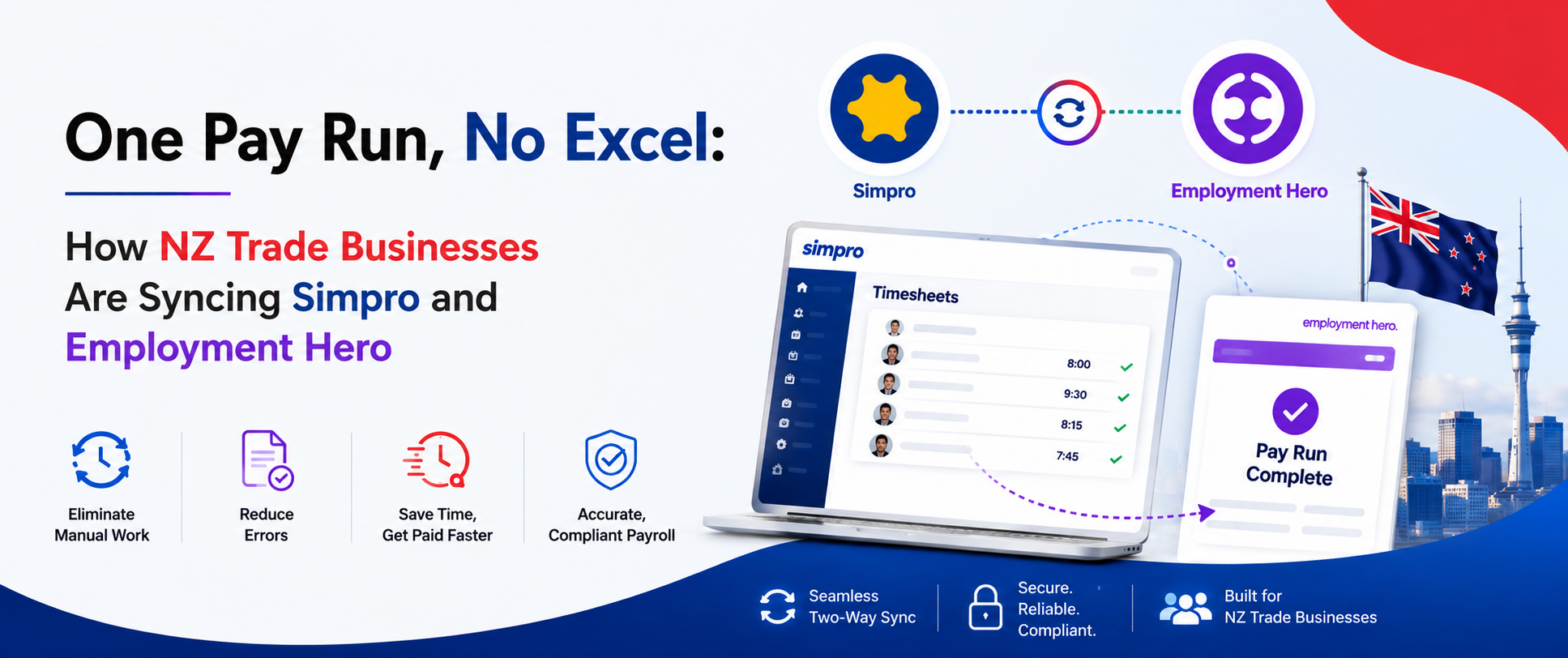
One Pay Run, No Excel: How NZ Trade Businesses Are Syncing Simpro and Employment Hero
Most New Zealand trade businesses we talk to don’t have a payroll system problem. They have a gap problem. Simpro runs the jobs. Your technicians log their hours against jobs, cost centres, activities and allowances. Employment Hero runs the pay. It knows the Holidays Act, it knows KiwiSaver, it knows what the IRD expects. Both… Continue reading One Pay Run, No Excel: How NZ Trade Businesses Are Syncing Simpro and Employment Hero
Hari Iyer | SyncEzy
CEO
HiBob + Employment Hero Payroll: A Field Guide for Enterprise Australian Payroll Teams
If you’re reading this, you’ve probably already made two good decisions and discovered they don’t talk to each other. Decision one: HiBob as your HR platform. It’s modern, employees actually use it, and your global HQ loves that everyone from Sydney to San Francisco lives in the same system. Decision two: Employment Hero Payroll —… Continue reading HiBob + Employment Hero Payroll: A Field Guide for Enterprise Australian Payroll Teams
Hari Iyer | SyncEzy
CEO
No More Month-End Exports: How Finance Teams Are Connecting Employment Hero to Power BI
Most finance teams running Employment Hero (KeyPay) don’t have one big payroll-reporting problem. They have a quiet, persistent one. The pattern shows up every month. Someone exports pay-run data into Excel. Someone else builds a pivot, formats it into a slide, and the leadership team reviews payroll cost from a deck built off data that’s… Continue reading No More Month-End Exports: How Finance Teams Are Connecting Employment Hero to Power BI
Hari Iyer | SyncEzy
CEO
Automate Your HR and Payroll Workflow: How the HiBob × Employment Hero Integration Actually Works
If you’re running HiBob for HR and Employment Hero for payroll, there’s a good chance someone on your team spends part of every pay cycle moving data between the two. A new hire goes into HiBob. Then into Employment Hero. A leave request is approved in HiBob. Then, it was keyed into payroll before Friday.… Continue reading Automate Your HR and Payroll Workflow: How the HiBob × Employment Hero Integration Actually Works
Hari Iyer | SyncEzy
CEO
SyncEzy SharePoint Integrations: What Microsoft 365 License Do You Need?
SharePoint is often the system of record for documents such as policies, drawings, SOPs, contracts, and compliance files. SyncEzy integrates SharePoint with platforms like Procore, Simpro, SafetyCulture, Autodesk Construction Cloud, Employment Hero, and Zoho, ensuring documents stay in sync across systems automatically. The Short Answer Microsoft 365 Business Basic is sufficient. SyncEzy works with the… Continue reading SyncEzy SharePoint Integrations: What Microsoft 365 License Do You Need?
Hari Iyer | SyncEzy
CEO

